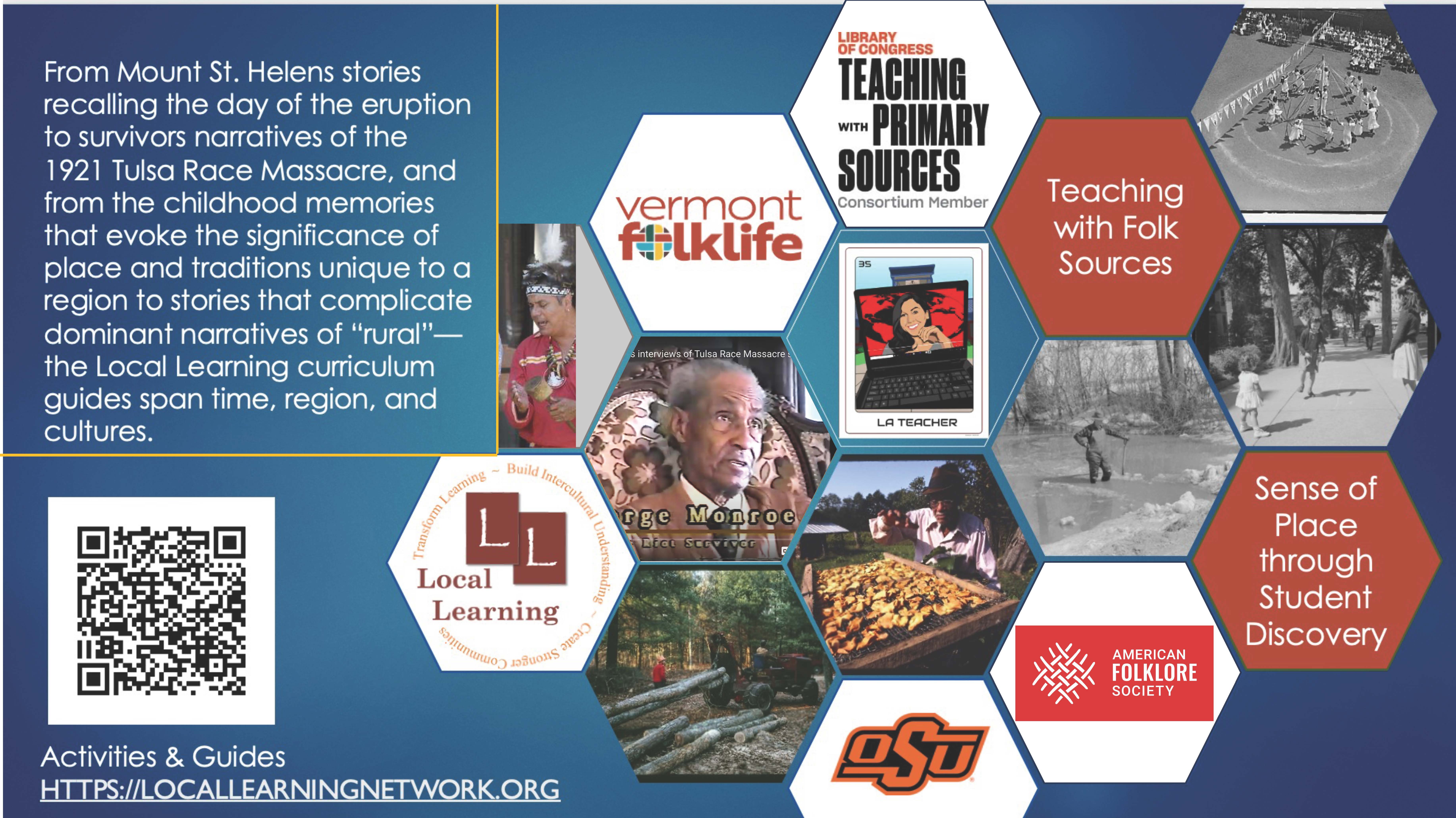
For close to thirty years, Local Learning, the national network for folklore and education, has brought folk and traditional arts into the classroom and other educational settings through its ground-breaking publications, workshops, and special projects. In 2020, Local Learning launched a partnership with the Library of Congress’s Teaching with Primary Sources (TPS) initiative, connecting local archives with the American Folklife Center’s holdings to activate folklife materials as a dynamic resource for teaching and learning.
Drawing upon examples from the American Folklife Center, the Oklahoma Oral History Research Program, and Vermont Folklife, this guided discussion emphasizes the powerful connection to be made between folklife archives and education. Beginning with an orientation in the principles of Teaching with Primary Sources, we will explore how identifying, interpreting, and curating materials from localized archives can generate small, purposeful source sets that resonate with K-12 and other education curricula, and with local communities.
Source sets are collections of oral history recordings and transcripts, photographs, and other primary documentary materials that can be used in educational settings to ground learning in the perspectives of those who have firsthand experience with a variety of topics. TPS source sets encompass historical eras and events, daily life in diverse cultures, and current issues. Folk source sets point towards folklife materials such as songs, artifacts, and more—the very items that are central to folklife documentation and archival collections. Local Learning’s work with the TPS exemplifies how everyday records, oral histories, and folklife documentation can be packaged to communicate their powerful potential to deepen understanding and expand historical and contemporary narratives.
Folk Arts Partners and Arts Education Peer Group colleagues had the opportunity to hear about this important work, and to consider how they might engage with the TPS, either as potential participants or as networkers who can connect the TPS program to their local communities. To learn more in advance of our session, browse the double issue of Local Learning’s Journal of Folklore and Education, which is devoted to the Teaching with Primary Sources initiative. Issue 1 contains a treasure trove of articles on Teaching with Folk Sources, and Issue 2 offers a Teaching with Folk Sources Curriculum Guide.


Presenters
Local Learning is a National Arts Service Organization that will bring their national faculty and local experts together to support this training opportunity.
Paddy Bowman is Founding Director of Local Learning and co-edits the Journal of Folklore and Education. Educators, artists, and arts administrators around the nation have benefited from her ability to connect non-folklorists with our discipline. She was awarded the American Folklore Society Benjamin A. Botkin Prize for Lifetime Achievement in Public Folklore and is a Fellow of the American Folklore Society. She has an MA in Folklore from the University of North Carolina.
Dr. Lisa Rathje is Executive Director of Local Learning. She directs teacher and artist training institutes and advocates for the inclusion of culture in diverse learning spaces. She consults nationally, including currently a 5-year consultancy for the REACH program of the University of South Florida funded by the U.S. Department of Education to strengthen arts and culture programming in the nation’s educational system. With Paddy Bowman, she is co-editor and founder of the Journal of Folklore and Education, an international, freely accessed, multimedia juried journal.
Library of Congress, American Folklife Center documents and shares the many expressions of human experience to inspire, revitalize, and perpetuate living cultural traditions. Designated by the U.S. Congress as the national center for folklife documentation and research, the Center meets its mission by stewarding archival collections, creating public programs, and exchanging knowledge and expertise.
Dr. Guha Shankar is Folklife Specialist in the American Folklife Center, Library of Congress, and a Fellow of the American Folklore Society. He is the Library’s liaison to Local Learning’s TPS consortium in which role he conducts research to locate and provide access to AFC and Library collections for curriculum development by consortium partners. He is the current co-Chair of OHA’s Task Force on Ethics and the Law, serves as project coordinator of Ancestral Voices – a collaborative curatorial initiative with indigenous communities, and co-directs the national Civil Rights History Project (in collaboration with NMAAHC) at the Library. Dr. Shankar also provides skills-based training in field research methods and archival preservation, including project planning, interviewing, photography, and archival best practices. He has extensive experience in media production, publishes in a range of traditional and digital media outlets, delivers public lectures and conducts technical workshops for a variety of audiences.
Oklahoma Oral History Research Program is a research division of the Oklahoma State University Library with the focus of broadening archival inclusion of individual or communal memory and experiences representing Oklahoma and OSU history and culture through ethical oral history practice.
Dr. Autumn Brown earned her Ph.D. in Social Foundations of Education from Oklahoma State University where she is an Assistant Professor in the Edmon Low Library with the Oklahoma Oral History Research Program. Her dissertation was an educational biography of teacher activist Clara Luper (1923-2011) and Luper’s work with Oklahoma City’s NAACP Youth Council leading one of our nation’s first sit-in movements.
Vermont Folklife is a nationally-known education and cultural research nonprofit that uses ethnography—the study of cultural experience through interviewing, participation and observation—to strengthen the understanding of the cultural and social fabric of Vermont’s diverse communities.
Mary Wesley is Director of Education and Media. She has a background in Anthropology and completed post-graduate training at the SALT Institute for Documentary Studies in audio production and multimedia storytelling. She supports Vermont Folklife’s public learning opportunities centered around ethnographic learning and media production and also helps coordinate the Vermont Traditional Arts Apprenticeship Program. Mary is also the founding producer and host of VT Untapped, VT Folklife’s own podcast that explores the state through the voices of its own residents.
Dr. Andy Kolovos is Associate Director and Archivist. He earned a BA in Literature from Bennington College, and holds a Ph.D. in Folklore and Ethnomusicology and an MLS, both from Indiana University. His professional interests include graphic ethnography/ethnographic cartooning, audio field recording, audio preservation, and theory and practice in folklore and folklife archives. He is co-coordinator of the National Folklore Archives Initiative project of the American Folklore Society.