Library of Congress Launches New Exhibition “Alive in Many Hands: The American Folklife Center at 50”
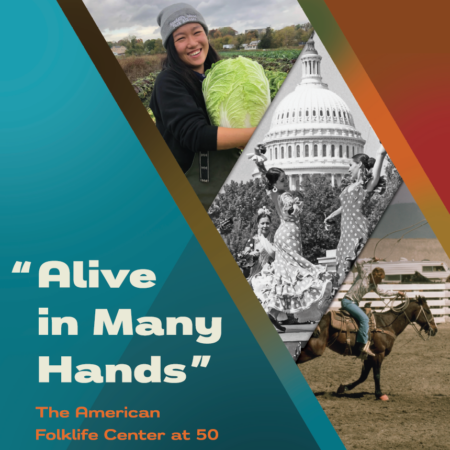
The Library of Congress has just launched “Alive in Many Hands: The American Folklife Center at 50,” a new exhibition showing how living traditions carry memory, identity and community across generations. Opened on September 18, this exhibition explores traditions of music and dance, storytelling, craft, foodways, work, celebrations and everyday community life.
Presented as part of a yearlong celebration of the American Folklife Center’s 50th anniversary, the exhibition brings together more than 150 objects, photographs, recordings and films to show how traditions are preserved, adapted and passed from hand to hand. Through materials spanning generations and communities, it explores how folklife connects people to one another and to the places, experiences and practices that shape them.
The American Folklife Center was established by Congress in 1976 to preserve and present American folklife. Today, the Center documents and shares expressions of human experience from communities across the United States and around the world, helping sustain living traditions while expanding public access to cultural memory.
“We want visitors to come away with a deeper understanding of how folklife is a cornerstone of the American experience. It reflects a living exchange of cultural forms and ideas that shapes and transforms our nation. It’s a way we see ourselves, our families and communities.”
Nicole Saylor, director of the American Folklife Center
Drawn from the American Folklife Center’s extraordinary collections, the exhibition emphasizes that folklife is not only something preserved from the past but also a living, evolving practice shaped by communities today.
“Alive in Many Hands” is organized around six sections that move from collecting and sharing traditions to the ways people experience, adapt and sustain them across generations and communities.
People share folklife through stories, music, objects and recordings that preserve human knowledge and experience. Items on display in this section include a Diné (Navajo) rug made by Bessie Taylor and a four-string banjo made in 1939 for folk song collector Frank Warner. The banjo bears the signatures of more than 260 people, including Woody Guthrie, Pete Seeger, Lead Belly, Odetta and Jean Ritchie.
This section includes a machine used by brothers Bruce and Sheridan Fahnestock in 1937 to record traditional music as they traveled across Southeast Asia. To capture audio on shore, they ran two miles of microphone cable directly from their ship to a Presto portable disc cutter. When their vessel later wrecked off the coast of Australia, this resilient machine was salvaged from the ship.
Food traditions can preserve memories of home, family and community. Items in this section range from “From the Kitchens of the Lower East Side: Recipes and Remembrances,” a community cookbook created by students at New York’s Seward Park High School, to a World War II-era chocolate ration preserved in the Veterans History Project.
Games, humor and informal traditions reveal another side of cultural life through the creative frame of play. Images of skateboarding, string figures, break dancing and a video game tent at a powwow present the wide range playful cultural practices comprising folklife. Objects in this section include dominoes, a wooden ball puzzle from the Blue Ridge Parkway Folklife Project and a 1940 letter from Guthrie to folklorist Alan Lomax titled “Vote for Bloat.”
Workplaces develop traditions, languages and customs of their own. This section includes a 1940 “crossing the line” certificate documenting a longstanding maritime ritual, as well as copies of “The Travelers’ Green Book” and “The Negro Motorist Green-Book,” guides that helped Black travelers navigate segregation and discrimination on the road.
Folklife always happens somewhere, and the collection items featured in this section illustrate the ways that cultural traditions are place-based. Whether urban or rural, public or private, on front porches or in open festival grounds, the section offers insight into the many spaces we find culture. Photographic documentation from the many large-scale folklife surveys that the Center conducted between 1977 and the mid-1990s illustrate the communities and traditions found in Chicago, Illinois, Lowell, Massachusetts, and across Montana, while recent images from the Little Bahamas neighborhood of Coconut Grove, Florida, share the vibrant Goombay cultural celebration.
Traditions endure when people continue to practice, adapt and pass them on. Houma culture bearer Janie Verret Luster revived the community’s half-hitch coil basketmaking tradition. Her palmetto basket is displayed alongside a moss doll and war club documenting other aspects of Houma cultural knowledge.
The exhibition also includes a sewing machine volunteers used to join individual panels of the AIDS Memorial Quilt. Begun in 1987, the quilt memorializes more than 110,000 people who have died of AIDS and is the largest piece of community folk art ever created.
“Alive in Many Hands” is on view in Southwest Exhibition Gallery, Thomas Jefferson Building, Library of Congress through January 8, 2028.
Those who cannot visit in person are invited to explore the online version of the exhibition.
We sometimes make mistakes, and we are happy to correct any errors that you may come across on our site. If you find an error, please let us know using the “submit a correction” link.