Negotiations of the Sacred: Kyoto’s Gion Matsuri and the Shifting Boundaries of a Japanese Festival by Elisabetta Porcu
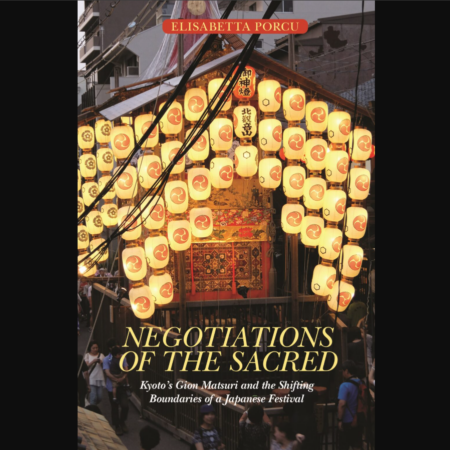
Negotiations of the Sacred (University of Hawai’i Press, 2026) offers a fresh perspective on one of Japan’s most famous festivals, the Gion Matsuri, held in Kyoto in July. Dating back more than a thousand years, the festival today features the parading of dozens of elaborate floats and portable Shinto shrines, accompanied by thousands of participants, through more than thirty downtown neighborhoods linked to Yasaka Shrine. Based on extensive fieldwork, this is the first book-length socio-anthropological analysis of the celebrated festival, one that examines it during a critical moment in its recent history: the 2014 reinstatement of the Gion’s second float procession (ato matsuri) after a fifty-year hiatus.
Elisabetta Porcu, professor of Asian religions and head of the Department for the Study of Religions at the University of Cape Town, follows the complex negotiations behind the festival and the reinstatement of the ato matsuri as she investigates the boundaries between sacred and secular geographies (the temporary shrine and governmental buildings) and the areas where these boundaries blur, such as the constitutional separation of religion and the state. Because tourism and traditional culture—and the Gion Matsuri in particular—play a prominent role in the promotion of Kyoto, Porcu’s study places the festival within glocalization processes to reveal the ways in which global influences are absorbed and reinterpreted according to local specifications and traditions. Throughout, she explores how power dynamics intersect with claims of authority, ownership, and distribution of the sacred.
Porcu’s own autobiography and positionality in the Global South and embodied experience of the matsuri, as well as her life in Kyoto, deeply shape the analysis and theoretical trajectory of this volume. As a woman scholar conducting research in the Gion Matsuri’s overtly male environment, she enriches the theoretical framing of her work by offering innovative insights on methodological issues related to gendered fieldwork, hegemonic power relations, and patterns of exclusion and control within contested spaces.
We sometimes make mistakes, and we are happy to correct any errors that you may come across on our site. If you find an error, please let us know using the “submit a correction” link.