Pre-Print JAF Issue on Folklore and AI (Spring 2027) Available Now
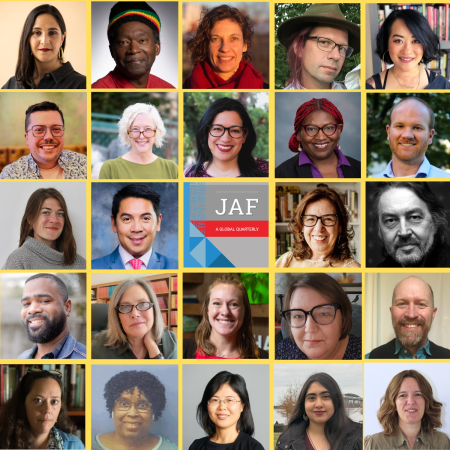
The Editorial Collective of the Journal of American Folklore has just submitted to press v. 140, no. 556, featuring a collection of essays on the theme of Folklore and Artificial Intelligence, that will arrive in print and online in Spring 2027. We’re excited about this issue, not only for its important contribution to our field, but for how it speaks to this rapidly changing moment in teaching, scholarship, and society at large. We’re eager to see it in print, but the good news is that we don’t have to wait to share it, because AFS and the authors have agreed to post pre-print versions of these essays immediately on the AFS website.
These pre-print pdfs will be available to read or download until the issue appears in the spring.
Themed Issue: Folklore and Artificial Intelligence
Introduction: Folklore and Artificial Intelligence
Articles
The Work of Art in the Age of Technofeudalism, by Kristiana Willsey
The Algorithm and the Storyteller: Artificial Intelligence-Mediated Folklore and Indigenous Storytelling in Northeast India, by Sylvia Sagolsem — images coming soon
Artificial Intelligence as Cultural Intermediary: Vernacularizing Greek Antiquity via Algorithmic Vlog Performance, by Aphrodite-Lidia Nounanaki
Dictionary as Grift, or Dictionary as Gift? Indigenous Lexicons, Generative Artificial Intelligence, and the Ethics of Extraction, by K. David Harrison, Hoài Trần, and Xơm A — images coming soon
A Sprinkling of Fairy Dust: Magicking Artificial Intelligence with the Sparkles Emoji, by Kirsty Asher — images coming soon
Perspectives
Tertiary Orality: Teaching in an Age of Artificial Intelligence, by Kimberly J. Marshall
Sovereign Interrogators: Fostering Prompt Literacy and Artificial Intelligence Audits in Decolonial Folklore Pedagogy, by Solomon Teshome
Thirsty Machines: Artificial Intelligence, Storied Waters, and Environmental History, by Rosita Scerbo
These are uncorrected advance copies of essays that have been formally peer reviewed and accepted for publication in Journal of American Folklore 140(556) but that have not received final copyediting, typesetting, pagination, or proof corrections. The final published versions may differ. The definitive, citable versions will be published in Spring 2027.
Terms of Use: These manuscripts are protected by copyright held by the Board of Trustees of the University of Illinois and are shared for personal, non-commercial use only. They may not be uploaded to public repositories, commercial sharing sites, or distributed further without explicit permission from the publisher.
Disclaimer of Liability and Endorsement: The views, opinions, and research findings expressed in all articles, reviews, and commentaries published in the Journal of American Folklore are strictly those of the respective author(s) and do not necessarily reflect the official policy, position, or endorsement of the Editorial Board, the Editorial Collective, the American Folklore Society, or the Trustees of the University of Illinois.
We sometimes make mistakes, and we are happy to correct any errors that you may come across on our site. If you find an error, please let us know using the “submit a correction” link.