2026 AFS Annual Meeting Presidential Invited Plenary: While the Folklore Is Still Young: Field Notes from the Vernacular Life of Artificial Intelligence

The American Folklore Society and AFS President Jason Baird Jackson are pleased to announce that the Presidential Invited Plenary at the 2026 Annual Meeting will be given by Dr. Maribel Alvarez. Her lecture, “While the Folklore Is Still Young” (see full title and abstract below), will be presented Thursday, October 29, 8:30–9:30 p.m. EDT in Grand Ballrooms A and B at the Renaissance Asheville Downtown Hotel.
Like many research projects, this one did not begin with a hypothesis. It began with a series of small moments that seemed, at first, too ordinary to matter: users confessing they hide their reliance on ChatGPT; people inventing nicknames for AI systems; a seventh grader defining artificial intelligence simply as “AI.” Taken alone, none of these moments appeared remarkable. Together, however, they suggested that something larger was taking shape—not inside the heated controversies surrounding AI, but in the everyday practices through which people are learning to live with it.
This talk grows out of that observation. Rather than asking whether artificial intelligence represents a radically new challenge to folklore studies, I ask what becomes visible when we attend ethnographically to the vernacular practices, moral negotiations, humor, folk theories, and habits emerging around large language models. Drawing on fieldwork as evaluator of an OpenAI-funded AI literacy initiative with Latino youth in Los Angeles, the early “architecting” of the Vernacular AI Archive, and my own ambivalent experience of incorporating chatbots into everyday professional life, I reflect on what it means to study folklore not after traditions have stabilized, but while they are still being improvised, contested, and incorporated into everyday life. My hope is not to offer conclusions about AI, but to open a conversation about what we may already be witnessing—and about the questions that emerge when we linger with these small, ordinary moments before rushing to explain them.
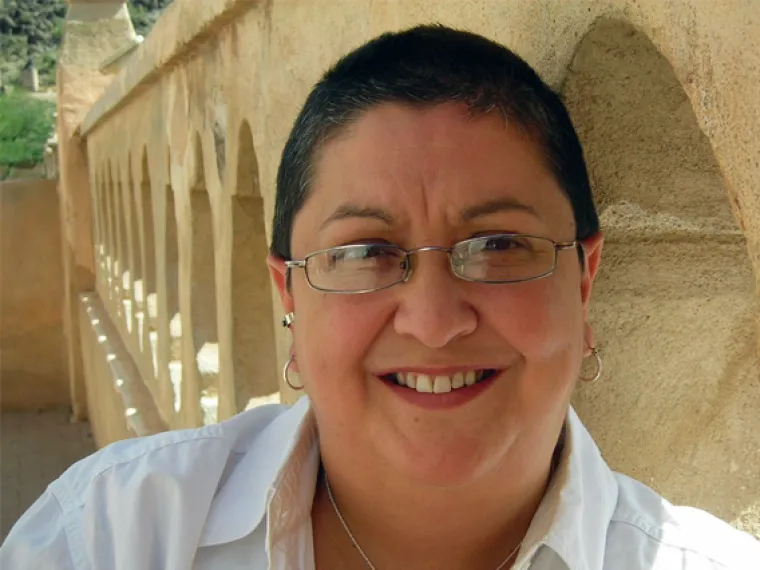
Dr. Maribel Alvarez is an anthropologist, folklorist, curator, and cultural organizer. She holds the Jim Griffith Chair in Public Folklore at the Southwest Center, University of Arizona (UA).
(Photo courtesy of UA)
From 2018–2021 Maribel served as the inaugural Associate Dean for Community Engagement in the College of Social & Behavioral Sciences. Her leadership helped produce the first study ever at UA on community perceptions of university interventions. In 2022, she was asked by the University Provost to lead a comprehensive strategic re-tooling of the university’s Office of Diversity and Inclusion. Maribel is the founder of the Southwest Folklife Alliance, which produces the annual Tucson Meet Yourself Folklife Festival in addition to other initiatives connecting heritage artists and ethnic food entrepreneurs to grassroots organizing and economic development. Southwest Folklife Alliance is an independent nonprofit affiliated with UA.
She has been a Fulbright Fellow in Sonora, Mexico, where she carried on a partnership with indigenous Yaqui communities around food and sovereignty. In 2021, with support from the Mellon Foundation, she co-founded the Northern Mexico Alliance for Folklore with her long-time collaborator, the distinguished Mexican anthropologist Guillermo Nuñez Noriega. In 1989, Maribel co-founded MACLA in San Jose, California—one of the most vibrant contemporary Latino art spaces in the United States. Maribel has served as a Trustee of the American Folklife Center at the Library of Congress. She has been an advisor for several philanthropic national initiatives on questions of equity, narrative strategy, and the generative power of changing demographics in the United States. She has served in the faculty of the National Association of Latino Arts and Cultures’ National Leadership Institute for 18 years, training and mentoring more than 400 Latinx and BIPOC leaders throughout the nation.
In the School of Anthropology at UA, Maribel teaches courses on methods of cultural analysis, with particular emphasis on objects, oral narratives, foodways, and the visual cultures of the US-Mexico border. Maribel has written and published essays about poetry and food, intangible heritage, nonprofits and cultural policy, the theory of arts participation, artisans and patrimony in Mexico, and popular culture and stereotypes. She is currently completing a cultural history of the contested “Sleeping Mexican” image, based on her research of more than 20 years and her private collection of more than 2,000 artifacts. In 2018 the American Folklore Society awarded her the prestigious Americo Paredes Prize for “excellence in integrating scholarship and engagement with the people and communities one studies.” Maribel self-describes as an immigrant, queer, first-generation college student. Born in Cuba, she grew up in Puerto Rico since age 7, but later came of age in California, where she became deeply involved in the Chicano/a arts movement as a poet, organizer, and advocate. Her doctorate in Cultural Anthropology is from UA.
(UA Faculty Profile © University of Arizona)
“Always pursuing and integrating public-facing, community-serving, and scholarly work at the cutting-edge, Maribel L. Alvarez is a true leader in the field of folklore studies and I am thrilled that she accepted my invitation to deliver the 2026 Presidential Invited Lecture during our upcoming annual meeting in Asheville, North Carolina.”
Jason Baird Jackson, AFS President
Commenting further, Jackson added: “Across more than two decades of engaged and critical scholarly practice on the US-Mexican border, Maribel is a colleague to whom many of us look for inspiration and leadership. This was true before the disruptions of our current moment, but it definitely remains true as both academic and public folklorists—alongside communities and community-based cultural workers—adjust to the many vexing challenges confronting us in the present moment.” Pointing to the subject of the lecture, he noted: “Maribel’s new work on the vernacular life of artificial intelligence could not be timelier, and I am thrilled that we will have the chance to learn with her when we convene in October.”
We sometimes make mistakes, and we are happy to correct any errors that you may come across on our site. If you find an error, please let us know using the “submit a correction” link.